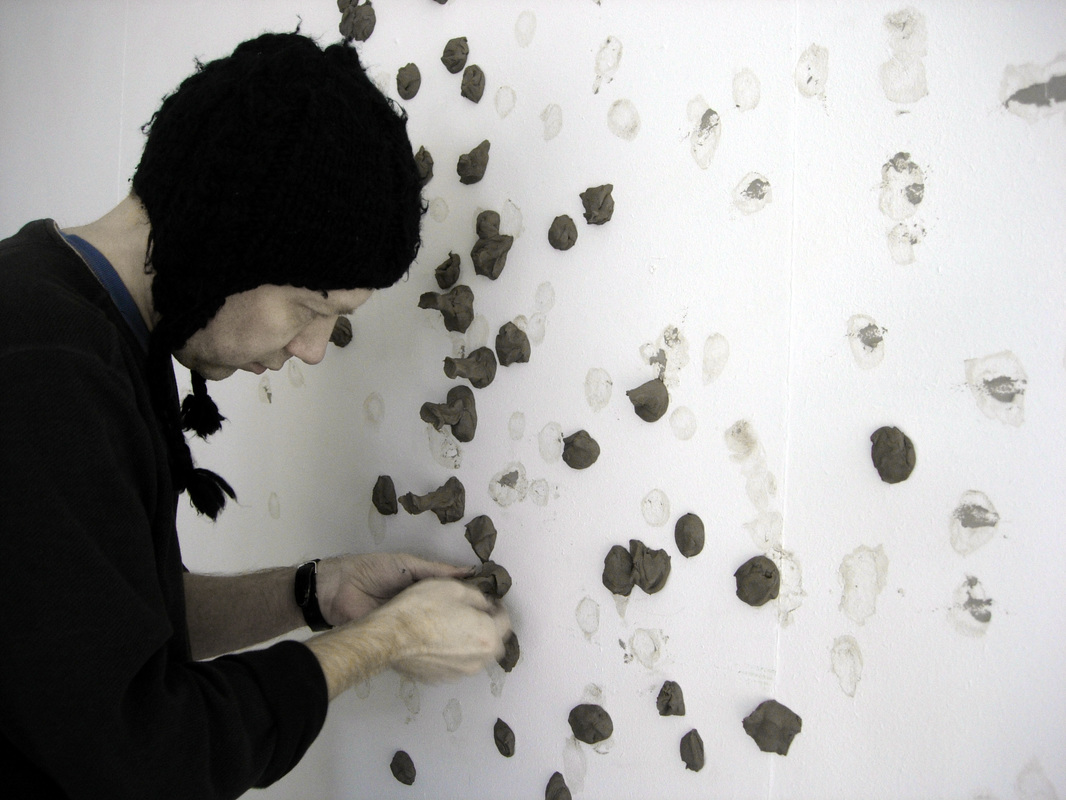
The term Glossolalia or more commonly known as, ‘Speaking in Tongues’ is embraced within the works. I define this work practice as,’ an undertaking of an action that results in the forming of an abstract visual language. My faculty is to understand the material language and henceforth to understand something of the inadequacies of all forms of language. Each person has his or her own language and the works interpretation may be both non-native and native; this is how an individual may respond to an unfamiliar language and whether they are either an outsider or as an insider to the language. Is it plausible that there is a recurrent parallel; an absolute alienation between languages…or is it that one could be a mere stranger to the language?’ My outpouring is akin to the vocalising of a fluent speech-like sound that however appears to be unintelligible.
Notes
1. The entropic nature of the substances and the causation of the event lead to the temporary re-shaping of a form.
2. In applying procedures for an interpretation of Speaking in Tongues I am required to contemplate being in two states. Firstly, to consider the intent of the work through the asking of questions as to why, and what (for example) the work is about…this is normal practice and rudimentary. The explanation is simply part of applying a justification to the act and thereafter to be able to articulate the reasoning behind an action. The written text supports the reasoning and is the testament that both behind the action (‘behind’ as implied here is that thought and reasoning follows an action) whilst it is also evident the act is also premeditated. The second state is of equal importance and possibly requires the greater discipline, the act of not thinking. I am increasingly interested in the application of the still mind in the moment…a process of contemplation or psycho-upsurge. This is simply drawing upon the self to undertake an action in the moment…I am not certain at this point how much I rely on the body’s ability to increase adrenaline.
3. I am caught firstly as to how I describe the actions…are the actions an implicit (if somewhat a mild form) of a violent act? It is perhaps a too stronger word to describe the works ‘coming into being’…that is not to say the premeditation of the act has not started well before the first projectile is pinched off the lump of clay. The act is certainly purposeful and I could suggest it is a work of energy. The premeditated aspects, the placement of the materials and props as well as the act are part of the works condition. The only true moment is not I believe the point in which the first projectile is released but the subsequent ones that follow. In all likelihood the action of the first one is acted out in my mind time and time again.
Action + Unknown possibilities = Results (The action undergoes a process of dissipation through a loss of energy...I use the term loss of energy here in the sense that the loss of energy is merely temporary...providing the clay is not fired. The energy is to be found in the materials water content).
Earthy and Soil like substances - Earthy Bon Bon's – PYKE (Pica) medical disorder - Pathology - Contaminated Dirt – or beneficial digestive aid - Clay- as a female food - A miasmatic substance – bad air /bile – stomach contents
2008
Taking a palm full of clay in my left hand I stand away from a wall (approximately 10 feet). Fixing my eyes upon a point on the wall I pinch off some clay and mould it into a ball in my right hand. I lift up my right arm with clay in hand and forcibly release the ball of clay towards the wall…’Splat.’ The process continues until sufficient clay has been embedded into the wall. The making of the work continues. Some of the clay forms on the wall are then pulled and pinched into columns, props or supports. Lengths of clay are then rolled out; these thin pole-like connectors are then attached to the clay supports. The work can be made and finished off site, however several semi autonomous choices are presented forthwith:
The work is now open to additional possibilities. Each option extends the vocabulary as to how the work can be interpreted. If the work is undertaken in the gallery (or other place of exhibition) the work has the ability to communicate to others (including the curators) in many different locations and in languages previously not yet explored by the artist.
1. The clay forms are removed whilst still wet. They are dried and fired. They are then reattached on to the wall.
2. The clay forms are left to dry on the wall, henceforth the clay hardens and falls off. The work is left broken and unfired on the floor. The clay marks from the throwing action remain on the wall.
3. The thrown clay is concentrated on to or near to one particular spot on the wall. The clay form is built up until it becomes one huge mass of clay. It is left to fall off in its own time.
4. The work incorporates a live art/performative element where the work is added to during the period of an event /exhibition
5. The work is fired and is presented in a new form (See example Vitrine and possible and cardboard box installations.)
6. The amount of clay thrown/stacked up against the wall at any one time is taken through to absurdity.
Taking a palm full of clay in my left hand I stand away from a wall (approximately 10 feet). Fixing my eyes upon a point on the wall I pinch off some clay and mould it into a ball in my right hand. I lift up my right arm with clay in hand and forcibly release the ball of clay towards the wall…’Splat.’ The process continues until sufficient clay has been embedded into the wall. The making of the work continues. Some of the clay forms on the wall are then pulled and pinched into columns, props or supports. Lengths of clay are then rolled out; these thin pole-like connectors are then attached to the clay supports. The work can be made and finished off site, however several semi autonomous choices are presented forthwith:
The work is now open to additional possibilities. Each option extends the vocabulary as to how the work can be interpreted. If the work is undertaken in the gallery (or other place of exhibition) the work has the ability to communicate to others (including the curators) in many different locations and in languages previously not yet explored by the artist.
1. The clay forms are removed whilst still wet. They are dried and fired. They are then reattached on to the wall.
2. The clay forms are left to dry on the wall, henceforth the clay hardens and falls off. The work is left broken and unfired on the floor. The clay marks from the throwing action remain on the wall.
3. The thrown clay is concentrated on to or near to one particular spot on the wall. The clay form is built up until it becomes one huge mass of clay. It is left to fall off in its own time.
4. The work incorporates a live art/performative element where the work is added to during the period of an event /exhibition
5. The work is fired and is presented in a new form (See example Vitrine and possible and cardboard box installations.)
6. The amount of clay thrown/stacked up against the wall at any one time is taken through to absurdity.
Exhibition & Events where Speaking in Tongues enquiries have taken place
Strata
Slab of wet clay, series of Ink jet prints (folded)
Painted shelf.
Clay is left to harden.
Exhibited August 2008 - Actual Wall
Exhibition: 'Strata' Oldknows Studio Group
2008
The Wheel Turns
10th January - 25th February 2011
Richard Attenborough Centre, Leicester.
The Wheel turns- a celebration of contemporary developments in collage and assemblage. The exhibition features the work of 34 artists.
For this show I exhibited two works - Document 1 & Document 2 (Speaking in Tongues)
Wildflowers
Nottingham Studios presents...
December 2010 - January 2011
A solo exhibition of some of my work, exhibited several 'Fresh' Speaking in Tongues
Beacon
Bimonthlies 4
An entertaining evening of artist presentations and performance.
Friday 18 March 7-10pm 2011
Location
Reading Room & Chapel
High Street
Wellingore
Lincoln LN5 0HW
Guest Artists
Simon Withers
Michael Sanders
Lincolnshire based artist
Edward Crumpton
Devonshire based artist
I would like to thank Beacon for inviting me to take part in Bimonthlies 4.
In Dialogue
Symposium
August 30th & 31st 2012
In June 2012 I responded to an open call out for papers to be part of an international symposium to be held in Nottingham. I submitted my provocation and was duly accepted.
I presented a Speaking in Tongues work at Primary. The dialogue had four constituent components.
Part 1 Thank You (9.15am)
In order to gain access to the outside area (where the work was to be located) a person would be required to exit/enter through an emergency exit door. At Primary this door is sometimes wedged open with a brick. For this event I removed the brick and replaced it with a block of clay. This action was decided upon in the morning of the symposium (Day 2). After dropping the clay against the door I inscribed the wet clay with the words ‘Thank You’. I thought this was rather appropriate as the clay was forming a particular function on my behalf…by offering the delegates easy access into the playground area.
Part 2 Form (10.20am)
Taking a block of clay I proceeded to throw it at the wall until it adhered. This short outburst required me to throw it three times at the wall until on the fourth occasion it remained in place.
Part 3 Emeth (12.00pm)
In front of me and painted on the wall was a painted outline of a square. I decided that this would be my target area. During the period of lunch I took my absence from the space and went outside to commence with throwing clay against the wall. I was reminded of playground activities and the timing for this action seemed appropriate. I had placed the large lump of clay upon a hopscotch design (painted at a time the school playground was used by infants). I decided that rather than use the whole block of clay I would leave in situ a remnant that contained part of the history of the action. The clay remaining has the trace marks of where I pinched the clay with my fingers. After the action (I had attempted to blot out the square with the clay) I wrote on the side of the block the work ‘Emeth’. The block was then placed back onto the hopscotch game (thus potentially interfering with any subsequent use of the squares).
(I think a variant on this will be to throw the clay in the aforementioned manner and to then try to remove the clay from the wall (after a brief period of hardening) before remodeling it back into a clay block)
Part 4 Truth (4.00pm)
Under the archway and where Part 3 had been acted upon there was a second painted square. ‘Truth’ occurred within seconds… cleanly and purposefully I forcefully pushed the clay against the brick wall within the parameters of the second square.
The works were returned to 24 hours later and removed…’Form’ remained in place and some of the more compacted clay from ‘Emeth’ remained on the wall.
In Dialogue was an International Symposium that took place at three sites across the city of Nottingham on the 30th and 31st August supported in kind by Nottingham Contemporary (day 1) & Primary (day 2). In Dialogue hosted an evening for symposium delegates at Community Hall in Sneinton including a communal meal from Marsha’s Secret Kitchen.
The symposium curators of In Dialogue, Heather Connelly, Viviana Checchia and Rhiannon Slade (doctoral researchers from Nottingham Trent and Loughborough University)
Primary
Event: Primary Spring Break
02/05/2013
Exhibited a Speaking in Tongues work connected with the yellow shelf (Mezzanine Space).
2 masses of wet clay, yellow shelf and subsidiary items. the work was coupled with a very different work also exhibited in the mezzanine space...I wrote at the time;
Open Skies and Speaking in Tongues bookend a gap of some nineteen years*. In-between the creation of one and the rehanging of the other, I bring to fruition (in PSB) a union of what may first appear to be two dissociated works. In essence these two works mirror my arts enquiry, it is one that inhabits intermediate space.
* The 'Gap' I refer to here references my first experiments undertaken with thrown clay whilst I was a student at Sheffield City Polytechnic. At some point during my second year and continuing into my third year I began to make assemblages using biscuit fired clay. If I had not taken ill during my final term of my third year it is possible my final degree show would have been an installation of wet clay thrown at the walls and ceiling and left to fall off during the course of the degree show. This way of working always intrigued me and so it was only a matter of time before I began to look at this work anew. I would say that my experiments remained unresolved (like many other works) at the end of my time as an Artist.
Strata
Slab of wet clay, series of Ink jet prints (folded)
Painted shelf.
Clay is left to harden.
Exhibited August 2008 - Actual Wall
Exhibition: 'Strata' Oldknows Studio Group
2008
The Wheel Turns
10th January - 25th February 2011
Richard Attenborough Centre, Leicester.
The Wheel turns- a celebration of contemporary developments in collage and assemblage. The exhibition features the work of 34 artists.
For this show I exhibited two works - Document 1 & Document 2 (Speaking in Tongues)
Wildflowers
Nottingham Studios presents...
December 2010 - January 2011
A solo exhibition of some of my work, exhibited several 'Fresh' Speaking in Tongues
Beacon
Bimonthlies 4
An entertaining evening of artist presentations and performance.
Friday 18 March 7-10pm 2011
Location
Reading Room & Chapel
High Street
Wellingore
Lincoln LN5 0HW
Guest Artists
Simon Withers
Michael Sanders
Lincolnshire based artist
Edward Crumpton
Devonshire based artist
I would like to thank Beacon for inviting me to take part in Bimonthlies 4.
In Dialogue
Symposium
August 30th & 31st 2012
In June 2012 I responded to an open call out for papers to be part of an international symposium to be held in Nottingham. I submitted my provocation and was duly accepted.
I presented a Speaking in Tongues work at Primary. The dialogue had four constituent components.
Part 1 Thank You (9.15am)
In order to gain access to the outside area (where the work was to be located) a person would be required to exit/enter through an emergency exit door. At Primary this door is sometimes wedged open with a brick. For this event I removed the brick and replaced it with a block of clay. This action was decided upon in the morning of the symposium (Day 2). After dropping the clay against the door I inscribed the wet clay with the words ‘Thank You’. I thought this was rather appropriate as the clay was forming a particular function on my behalf…by offering the delegates easy access into the playground area.
Part 2 Form (10.20am)
Taking a block of clay I proceeded to throw it at the wall until it adhered. This short outburst required me to throw it three times at the wall until on the fourth occasion it remained in place.
Part 3 Emeth (12.00pm)
In front of me and painted on the wall was a painted outline of a square. I decided that this would be my target area. During the period of lunch I took my absence from the space and went outside to commence with throwing clay against the wall. I was reminded of playground activities and the timing for this action seemed appropriate. I had placed the large lump of clay upon a hopscotch design (painted at a time the school playground was used by infants). I decided that rather than use the whole block of clay I would leave in situ a remnant that contained part of the history of the action. The clay remaining has the trace marks of where I pinched the clay with my fingers. After the action (I had attempted to blot out the square with the clay) I wrote on the side of the block the work ‘Emeth’. The block was then placed back onto the hopscotch game (thus potentially interfering with any subsequent use of the squares).
(I think a variant on this will be to throw the clay in the aforementioned manner and to then try to remove the clay from the wall (after a brief period of hardening) before remodeling it back into a clay block)
Part 4 Truth (4.00pm)
Under the archway and where Part 3 had been acted upon there was a second painted square. ‘Truth’ occurred within seconds… cleanly and purposefully I forcefully pushed the clay against the brick wall within the parameters of the second square.
The works were returned to 24 hours later and removed…’Form’ remained in place and some of the more compacted clay from ‘Emeth’ remained on the wall.
In Dialogue was an International Symposium that took place at three sites across the city of Nottingham on the 30th and 31st August supported in kind by Nottingham Contemporary (day 1) & Primary (day 2). In Dialogue hosted an evening for symposium delegates at Community Hall in Sneinton including a communal meal from Marsha’s Secret Kitchen.
The symposium curators of In Dialogue, Heather Connelly, Viviana Checchia and Rhiannon Slade (doctoral researchers from Nottingham Trent and Loughborough University)
Primary
Event: Primary Spring Break
02/05/2013
Exhibited a Speaking in Tongues work connected with the yellow shelf (Mezzanine Space).
2 masses of wet clay, yellow shelf and subsidiary items. the work was coupled with a very different work also exhibited in the mezzanine space...I wrote at the time;
Open Skies and Speaking in Tongues bookend a gap of some nineteen years*. In-between the creation of one and the rehanging of the other, I bring to fruition (in PSB) a union of what may first appear to be two dissociated works. In essence these two works mirror my arts enquiry, it is one that inhabits intermediate space.
* The 'Gap' I refer to here references my first experiments undertaken with thrown clay whilst I was a student at Sheffield City Polytechnic. At some point during my second year and continuing into my third year I began to make assemblages using biscuit fired clay. If I had not taken ill during my final term of my third year it is possible my final degree show would have been an installation of wet clay thrown at the walls and ceiling and left to fall off during the course of the degree show. This way of working always intrigued me and so it was only a matter of time before I began to look at this work anew. I would say that my experiments remained unresolved (like many other works) at the end of my time as an Artist.
Further Enquiries lead to the making of work for Display, a series of small curated exhibitions in five display cases at Primary.
Primary
DISPLAY 5
Speaking in Tongues
02.05.2013
These shapes…these forms, these objects of possibility are yet more Speaking in Tongues compositions…This sculpture, soft, malleable, and error ridden unhurriedly transforms into a hard, error ridden object…an object thrown to be thrown away…however a few of these works remain, several have been turned into pots…I call them pots (ceramic ware) because their foundation has been altered; changed and redefined by an act of firing…they have become stable.
This pairing shall remain unstable…I may reuse the clay for a future SiT work…or possibly I may consider the possibility that this will be all the clay I will use in future SiT’s…but this is speculating the future…more work for thee to do.
Present within Display the ‘Speaking in tongues’ work continues my interpretive enquiry into the nature of visual language and prospects my continuing dialogue with the dematerialisation of Art (within my practice). The work considers ‘otherness’ and the unfamiliar, the artist travels delicately and lightly; with little by way of material baggage he becomes self-reliant, producing work in the moment...all his experiences are contained within the material. In the case of ‘Speaking in Tongues’ a physical object can be temporarily created and I have the possibility of returning the hardened material back into a state of mutability should I elevate, develop and retain the unfired, un-made option. It is an art that may suggest the primitive, a work in an infancy…why I do what I do may not always be self evident or clearly understood…I do not necessarily move forward with foresight, I move forward not knowing where the next step shall take me.
If the aforementioned is my generic ‘default’ position for the SiT works, then these ‘decorative’ interpretations are a departure from the more rudimentary work produced (under the auspicious title, ‘Speaking in Tongues’). Several factors emerge (to aid navigation); the works vitality is present in three interchanges (Acts 1, 2 & 3). The first act is, ‘intension’ (my volition), the second act is the period in which the substance (having been released from my grasp) temporarily arcs in the ether. The third act considers the repercussion (after the fall).
Notes from, ‘Speaking in Tongues and how to enjoy them.’
Souvenir
2013
Unfired clay, household primer, spray pair and inkjet transfers.
The image is of the Duomo in Milan.
Satsuma Ware (article 104)
2013
Fired Clay, household primer, spray paint and ink jet transfer decals.
Funny Ha Ha
2013
Fired Clay, household primer, spray paint and ink jet transfer decals.
The Cocktail Hour
2013
Fired Clay, household primer, spray paint and ink jet transfer decals.
Also exhibited as part of Display 5 were the following items, these were placed within 'The Twins' two small cases positioned in close approximate to each other.
Back Stamp (fragmentation)
Crested china (fragmentation) - Items found at the former Falcon Pottery (stoke-on-Trent)
Images are from the exhibition, DISPLAY 5 / Primary / OCT - NOV - 2013.
These shapes…these forms, these objects of possibility are hitherto more Speaking in Tongues compositions…These sculptures, soft, malleable, and error ridden unhurriedly transform into a hard, error ridden objects…objects thrown to be thrown away…however a few of these works have become stable and have been turned into decorated pots…I call them pots (ceramic ware) because their foundation has been altered; changed and redefined by an act of firing…they have become stable.
Some of these works however remain unstable…I may reuse the clay for a future SiT work…or possibly I may even consider the possibility that this will be all the clay I will use in future SiT’s…but this is speculating the future...See last slideshow!
